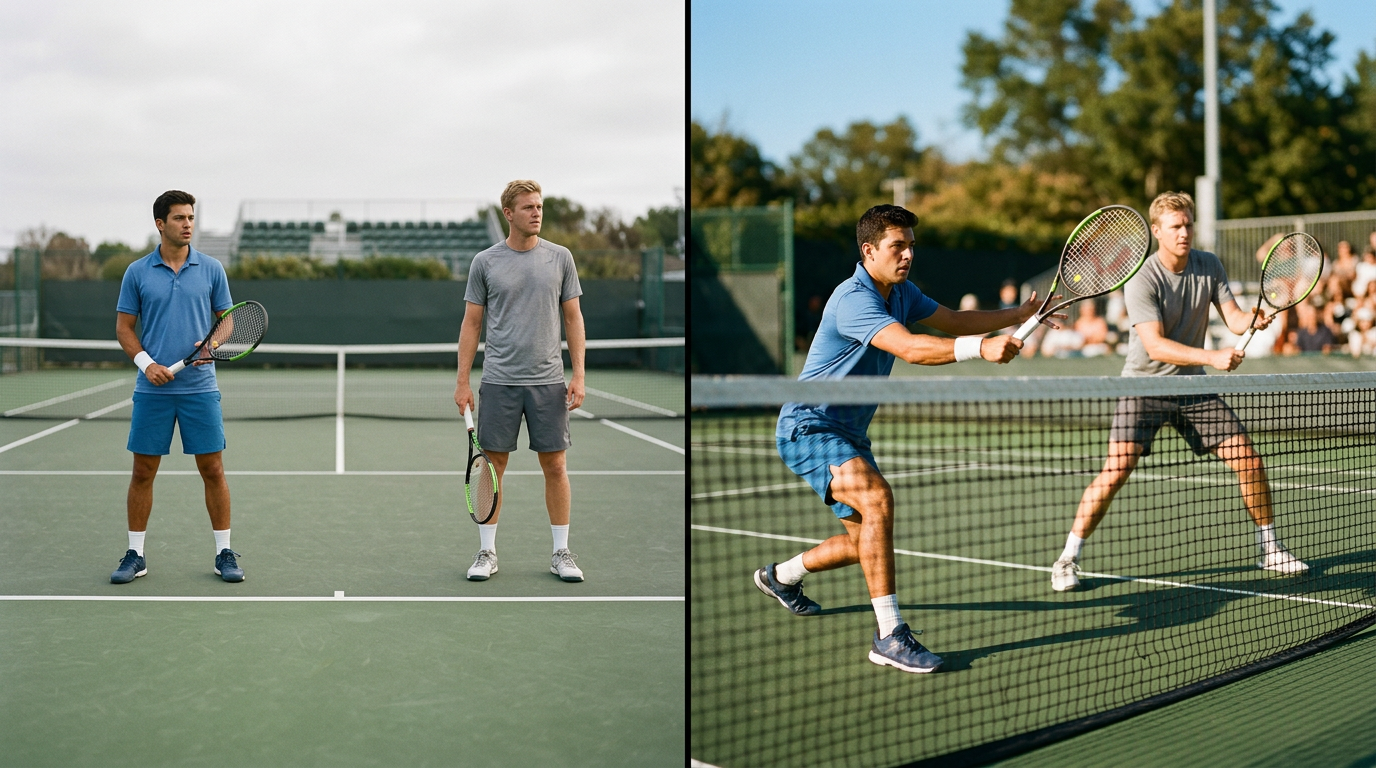
Most intermediate doubles players spend 80% of their practice time doing the one thing that matters least in doubles: hitting groundstrokes from the baseline.
It's not their fault. Singles habits are deeply ingrained. You show up to practice, you rally cross-court, you call it preparation. But doubles at the USTA 3.5 and 4.0 level is won and lost at the net, on the return, and through split-second communication between partners. If your drills don't reflect that reality, you're training yourself to lose.
This article lays out the six drills that most directly fix the weaknesses that cost intermediate doubles players points — and helps you figure out which ones to prioritize first based on how your team actually struggles.
Why Generic Drilling Doesn't Transfer to Doubles Match Play
Here's the thing about doubles: it's a completely different sport from singles, and most players treat it like a singles game with an extra person on the court.
The scoring geometry is different. The net player changes every shot's calculation. Poaching, lobbing, and switching positions happen in fractions of a second. And yet, walk onto any public court on a Tuesday night and you'll see two pairs of doubles players grinding baseline rallies with both net players standing frozen like furniture.
At the 3.5 level, the most common point-ending patterns involve net position errors, missed volleys on easy balls, and returns that go straight to the net player. At 4.0, add in failed poach attempts and lob recovery miscommunication. These are the problems worth drilling.
These drills are designed to reinforce the positioning concepts these drills are designed to reinforce — so if you haven't read that piece first, it's worth 10 minutes of your time before you step on court.
The 6 Drills That Most Directly Improve Doubles Performance
Drill 1: The Cross-Court Consistency Rally (Returner Focus)
The match problem it solves: Returners at the 3.5–4.0 level consistently miss returns wide or into the net player's wheelhouse.
Setup: Returner stands in normal service return position. Server feeds live serves from the deuce or ad court. Net player stands in standard position but does not poach — they're a passive observer for this drill.
The work: Returner's only job is to keep 10 consecutive returns low and cross-court, away from the net player. Not a winner. A controlled, angled ball that lands in the service box or just beyond.
This drill sounds simple. It isn't. Most intermediate players discover they can't do it consistently under any pressure at all — which is exactly why it matters. Once you can hit 10 in a row, add the net player back in as an active poacher.
Drill 2: Serve-and-Approach with Net Player Movement
The match problem it solves: Server hits serve and stands on the baseline while their partner does all the net work. This leaves the team in a lopsided formation.
Setup: Server serves from normal position. After serving, they must advance to the net (crossing the service line) within two steps of the return landing.
The work: Net player mirrors the server's approach — they shift toward the middle as the server closes in. Returners try to exploit the transition. Run this drill until both server and net player reach the correct two-up formation at least 70% of the time.
And yes, you'll lose some points during the transition. That's fine. A team that consistently arrives at two-up wins more points than one that never gets there.
Drill 3: The Poach Trigger Drill with Live Signals
The match problem it solves: Net players either never poach (too passive) or poach randomly (no coordination with partner).
Setup: Full doubles point play, but before each point, the net player gives their partner a hand signal behind their back — open hand = poach, closed fist = stay.
The work: The server adjusts their serve placement based on the signal. Net player executes the signal, no matter what. This forces commitment and removes the hesitation that kills poach attempts at the 3.5–4.0 level.
The first few sessions will feel chaotic. That's normal. The point isn't to win every poach — it's to build the communication habit and the muscle memory of committing to a decision before the ball is in play. (This is the same logic behind any pre-snap call in football, if that analogy helps.)
Drill 4: Two-on-One Net Pressure (Volley Reaction)
The match problem it solves: Net players freeze or pop up easy balls when the opposing team attacks the net together.
Setup: One player stands at the baseline feeding balls. Two players stand at the net in standard doubles net position. The feeder hits directly at one of the net players, mixing pace, direction, and height.
The work: The two net players must volley cooperatively — calling "mine" or "yours" out loud before contact. The goal is 15 consecutive successful volleys without a frame or popped ball.
This drill builds volley reflexes, but more importantly it builds the verbal communication pattern that stops partners from colliding on middle balls. Short, fast, loud: that's the cue.
Drill 5: Lob Recovery and Overhead Positioning Reset
The match problem it solves: When a lob goes over the net player's head, both players either freeze or crash into each other trying to retrieve it.
Setup: Two teams in standard doubles formation. Feeder (or server) deliberately lobs over the net player.
The work: Net player calls "back" immediately and retreats. Baseline partner calls "switch" or "yours" to clarify who takes the overhead or retrieval. The team resets — one partner covers the lob, the other repositions to cover the net.
Run this drill until the verbal cues happen before the ball bounces. At the 4.0 level, the lob recovery sequence is nearly automatic for experienced teams. For most 3.5 teams, it's a genuine crisis every time it happens.
Drill 6: Middle Ball Decision Drill
The match problem it solves: Balls hit down the middle of the court create confusion, hesitation, and free points for the opponents.
Setup: Feeder hits balls directly between two players positioned at net or in a split formation.
The work: Before the drill begins, teams agree on a decision rule: forehand takes it, or ad-side player takes it, or higher-ranked player takes it. Then the feeder fires 20 consecutive middle balls. Teams must execute the agreed rule every time — no negotiating mid-point.
The specific rule matters less than having one. Teams that decide in advance beat teams that decide in the moment.
How to Structure a 60-Minute Doubles Practice Session
Here's a framework that works for most intermediate doubles teams:
| Time Block | Activity | Purpose |
|---|---|---|
| 0–10 min | Cross-court consistency rally (Drill 1) | Warm-up + return focus |
| 10–25 min | Serve-and-approach + poach trigger (Drills 2 & 3) | Net transition + coordination |
| 25–40 min | Two-on-one net pressure + middle ball (Drills 4 & 6) | Volley reaction + decision rules |
| 40–50 min | Lob recovery drill (Drill 5) | Overhead + reset communication |
| 50–60 min | Live doubles points with one constraint | Integration + pressure |
The 'one constraint' in the final 10 minutes is key. Pick a single focus — 'every net player must attempt at least one poach per service game' — and play live points with that rule active. This is how drills become habits.
Which Drills to Prioritize Based on Your Biggest Weakness
Not every team needs to work on everything. Here's a self-diagnosis guide:
If You Struggle at Net
You're losing points on volleys you should be winning, popping balls up, or retreating from balls you should be attacking. Start with Drills 4 and 6 every session. Add Drill 3 once your volley confidence improves. The goal is to stop treating the net like a danger zone and start treating it like a scoring position.
If You Lose Points on the Return
Your return is either going into the net player or missing wide under pressure. Drill 1 is your entire practice for the first two sessions. Seriously — just that drill. Then layer in Drill 3 so you understand what the net player is doing when you're returning, which changes your target selection instinctively.
If Your Team Has Communication Breakdowns
You're playing side-by-side without actually functioning as a team. Drills 3, 5, and 6 are your priority — all three are fundamentally about verbal coordination. If you haven't yet established pre-point signals, agreed lob recovery calls, and a middle-ball rule, you're leaving easy points on the table every match.
So, a quick honest note here: most teams fall into all three categories to some degree. Pick your biggest problem first, spend two to three sessions on it, then rotate.
Getting the Most From These Drills Without a Coach Present
Look, not every practice session includes a coach watching your footwork. But you can still run effective drills without one, if you structure the session deliberately.
Assign one partner to be the 'director' for each drill — they call out corrections, count reps, and enforce the constraint. Rotate that role each session. This creates accountability and sharpens both players' understanding of what good execution looks like.
Record short video clips on your phone. You don't need to watch every minute — just the moments right after a missed volley or a failed poach attempt. Pattern recognition happens fast when you can actually see yourself hesitating.
And if you want to accelerate the learning curve significantly, get structured doubles practice with a qualified tennis coach. Drills done incorrectly build bad habits faster than no drills at all. A coach watching your net player's split step or your return stance can cut weeks off the feedback loop.
For players weighing whether the investment makes sense, Is Hiring a Tennis Coach Actually Worth It? breaks down the math honestly.
If you're exploring group formats as a way to get coached reps without the full cost of private sessions, Group Tennis Lessons vs. Private Lessons covers what each format actually delivers in terms of skill development.
What to Do This Week
Pick one drill. Just one. Based on your team's biggest current weakness, choose from the list above and run it for 20 minutes at your next practice session. Don't try to overhaul your entire game in one session — that's how teams end up frustrated and reverting to baseline rallies.
Track how many consecutive reps you can complete cleanly. Write it down. Come back next week and try to beat that number.
That's it. Improvement in doubles isn't about finding some secret tactic. It's about doing the boring, specific, repetitive work that singles players skip — and showing up to match play with habits instead of hopes.